A search, then links
- 01Type a few keywords
- 02Open several websites
- 03Compare prices, photos, and reviews
- 04Build the shortlist yourself

Hospitality · AI presence
A traveler can now describe exactly what they're looking for to an AI assistant: mood, location, quiet, amenities, family needs, or timing. The assistant compares the options and can shortlist hotels before ever visiting their website.
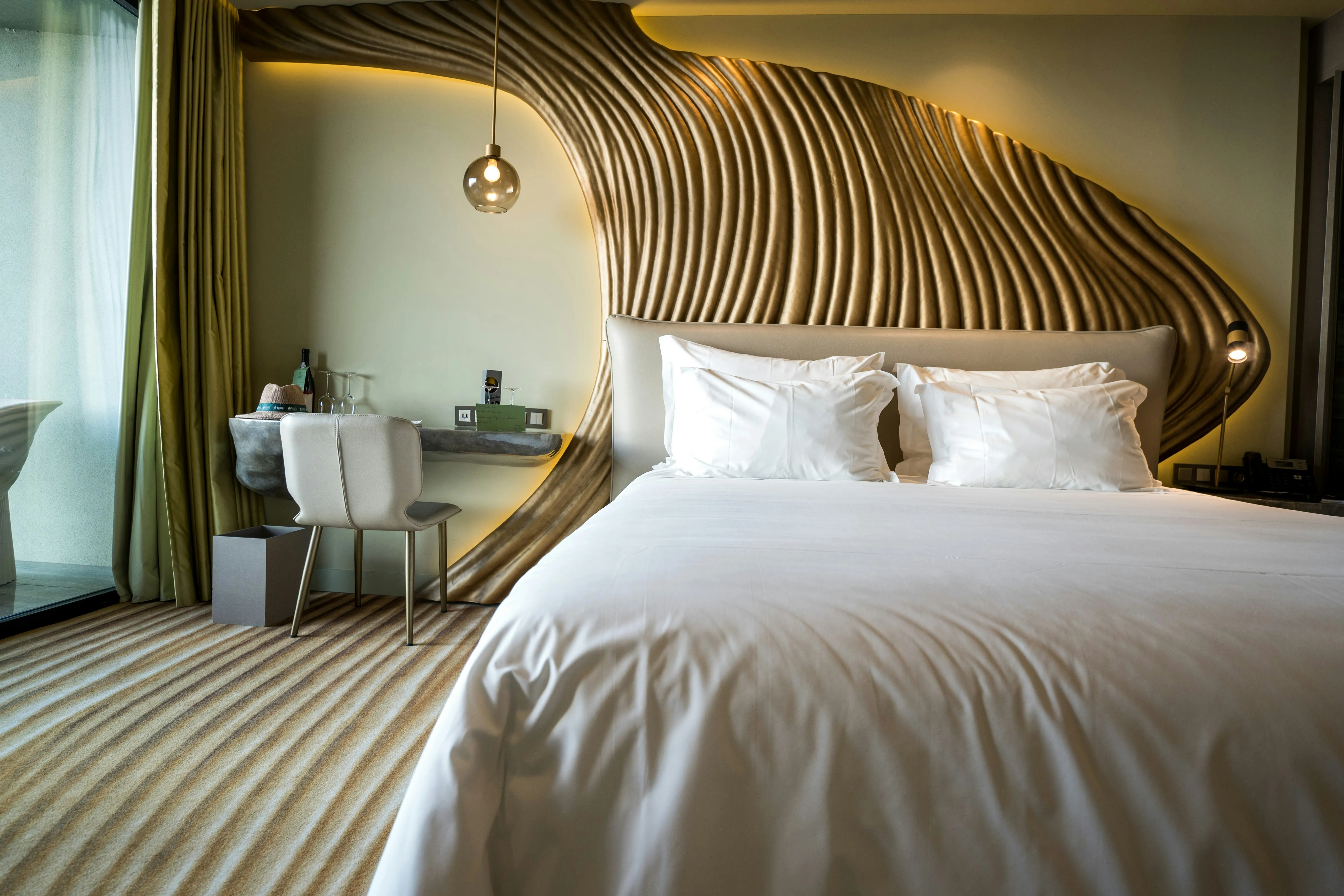

Your hotel
AI Presence
Find me a hotel with character in Lyon for a family weekend: quiet, central, with a real breakfast.
Hôtel Maison Belles
Lyon · Boutique Hotel
€€ · 4.7 (284)
View rooms & bookThe shift
The journey isn't disappearing: it sometimes starts elsewhere. Travelers no longer just compare pages and result lists. They can describe their stay, their constraints and preferences directly, then ask an assistant to suggest the most suitable options.
“Find me a hotel with character in Lyon for a family weekend: quiet, central, with a real breakfast.”
A hotel absent from the answer doesn't just lose a click: it risks never entering the traveler's shortlist at all.
The double intermediation
OTAs intermediated the booking. AI assistants can now intermediate discovery and comparison too.
If the assistant mostly finds information on Booking, Expedia, or other platforms, it's their version of your hotel that it will use to build its answer. What actually sets you apart (atmosphere, how you welcome families, room quirks, services, or experience) then risks disappearing behind price, star rating, and reviews.
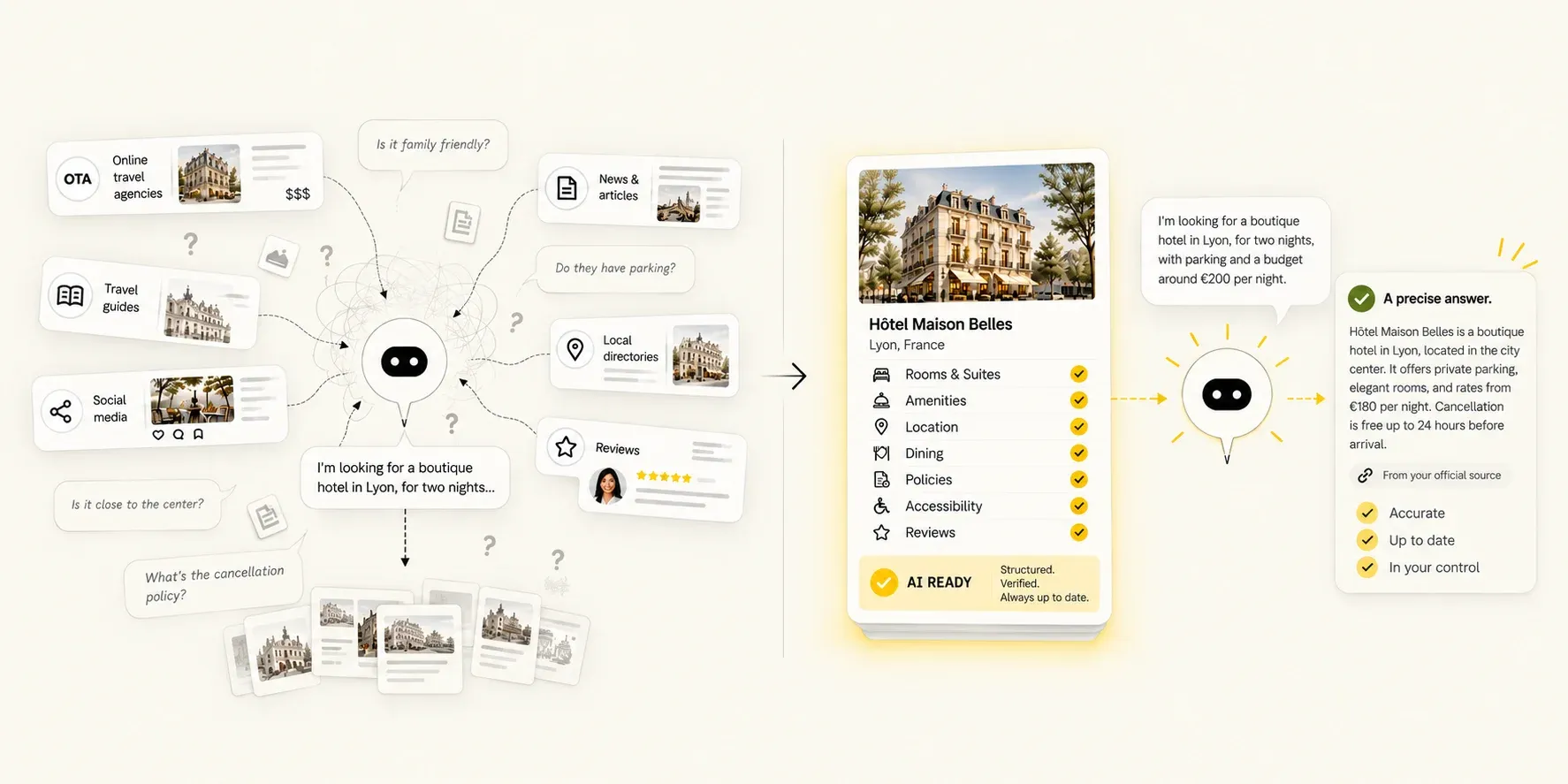
You don't just lose the click. You lose the narrative that comes before the click.
The real problem
Your hotel already has most of the answers: on the website, in room descriptions, brochures, maps, policies, business tools, and above all in your teams. The problem is that this information is scattered and rarely available in one place.
What you already have
What travelers ask
The problem isn't a lack of information. It's that it isn't gathered into a reliable, up-to-date source validated by the hotel: one able to answer differently depending on the traveler's question.
Two complementary uses
SEO remains essential to being found and cited. But assistants open up another use: answering a question directly from information the hotel has validated.
Your pages can be indexed, summarized, and sometimes cited. You increase the odds that your hotel appears, without controlling the final answer or the other sources used.
Example use
A traveler is looking for a quiet hotel in Lyon. Your pages can be found, then combined with reviews, OTAs, and other sources.
Compatible experiences can answer from structured information, kept up to date and validated by your teams. The same source can also serve your own channels.
Example use
A traveler asks whether a room suits their family. The answer relies on your information, then sends them back to your booking engine to check availability.
The two approaches complement each other: one helps your hotel get found, the other lets you answer from your own information.
The Weftd answer
Weftd gathers and structures the information you already have into a reference source, validated by your teams and usable in several languages. The Space complements your website and existing tools; it doesn't replace them.
Import the website, brochures, room descriptions, maps, and other useful content.
Connect rooms, services, offers, policies, hours, experiences, and practical information, then make it available in several languages.
Validate the information before it becomes a reference for answers. Nothing is presented as hotel-validated without your control.
Use that same source on a conversational page, your website, and compatible assistants.
You structure the information once, then reuse it across several touchpoints.
One source, two uses
Help assistants better understand your rooms and services, answer in the traveler's language, and send them back to your direct channels when they want to book or get in touch.
Give front desk, reservations, concierge, and marketing the same validated information, easy to find and reuse.
Example scenario
A sample scenario: not a live assistant.
Traveler's question
“Which room best suits two adults and a four-year-old?”
Information used
Sample answer
What you take back
You stay in control of how your rooms, services, and what sets your hotel apart are described.
The same information can be used differently depending on what the traveler is looking for.
The same information can serve answers in several languages, without maintaining a separate base for each market.
When a traveler is ready to book, the answer can send them back to your booking engine or your other direct channels.
The whitepaper
This page summarizes the issue. The whitepaper details what's changing in hotel search, the risks tied to this new intermediation, and the concrete steps to prepare your establishment.
Frequently asked questions
No. Your website remains the place for branding, reassurance, and conversion. The Space complements it by organizing validated information so it can be found and reused.
No. A chatbot is an interface. The Space gathers the reference information that can feed a conversational page, but also other compatible channels and assistants.
No. No one controls an assistant's final answers. Structured, validated information helps the hotel be better understood; it never guarantees a recommendation.
They stay managed by your business systems. The Space provides useful information, then sends travelers back to your channels or to the connections actually available to complete the action.
No. SEO remains essential to making your pages visible and citable. Weftd answers a different need: letting compatible experiences use information the hotel has validated.
Independent hotels are the priority audience, since they rarely have the AI teams that major groups do. The logic also extends to collections and groups that want to share consistent information across several properties.
Weftd replaces neither, and shouldn't be presented as integrated by default. The connections actually available are checked with your team based on your tools and your project.
The starting point can bring together your website, room descriptions, brochures, maps, policies, hours, and practical information, plus the answers already held by front desk, reservations, and concierge.
Your teams stay in control of the reference information. Responsibilities, the validation cadence, and update methods are defined with the hotel during scoping.
Stay in control of the source
Discover what's changing with the whitepaper, or talk to Weftd about how to structure your establishment's information.