Classic search
Annecy6 guestsPoolParking

Vacation rentals · 2026 whitepaper
Weftd gathers and structures your property's information so AI assistants can understand it, verify it, and reuse it: before, during, and after the stay.


Your rental
AI Presence
I'm looking for a quiet house near Annecy for a family with two young children, a late arrival, easy parking, and rainy-day activities nearby.
Villa des Oliviers
Sévrier · Entire home
€€ · 4.8 (124)
View details & book01 · The shift
Destination, dates, capacity: these filters still matter. But travelers can now specify that they're arriving late, traveling with young children, need easy parking, or want rainy-day activities nearby. The assistant interprets these details and shortlists properties before the traveler even opens a listing.
“A quiet house near Annecy for a family with two young children, a late arrival, easy parking, and rainy-day activities nearby.”
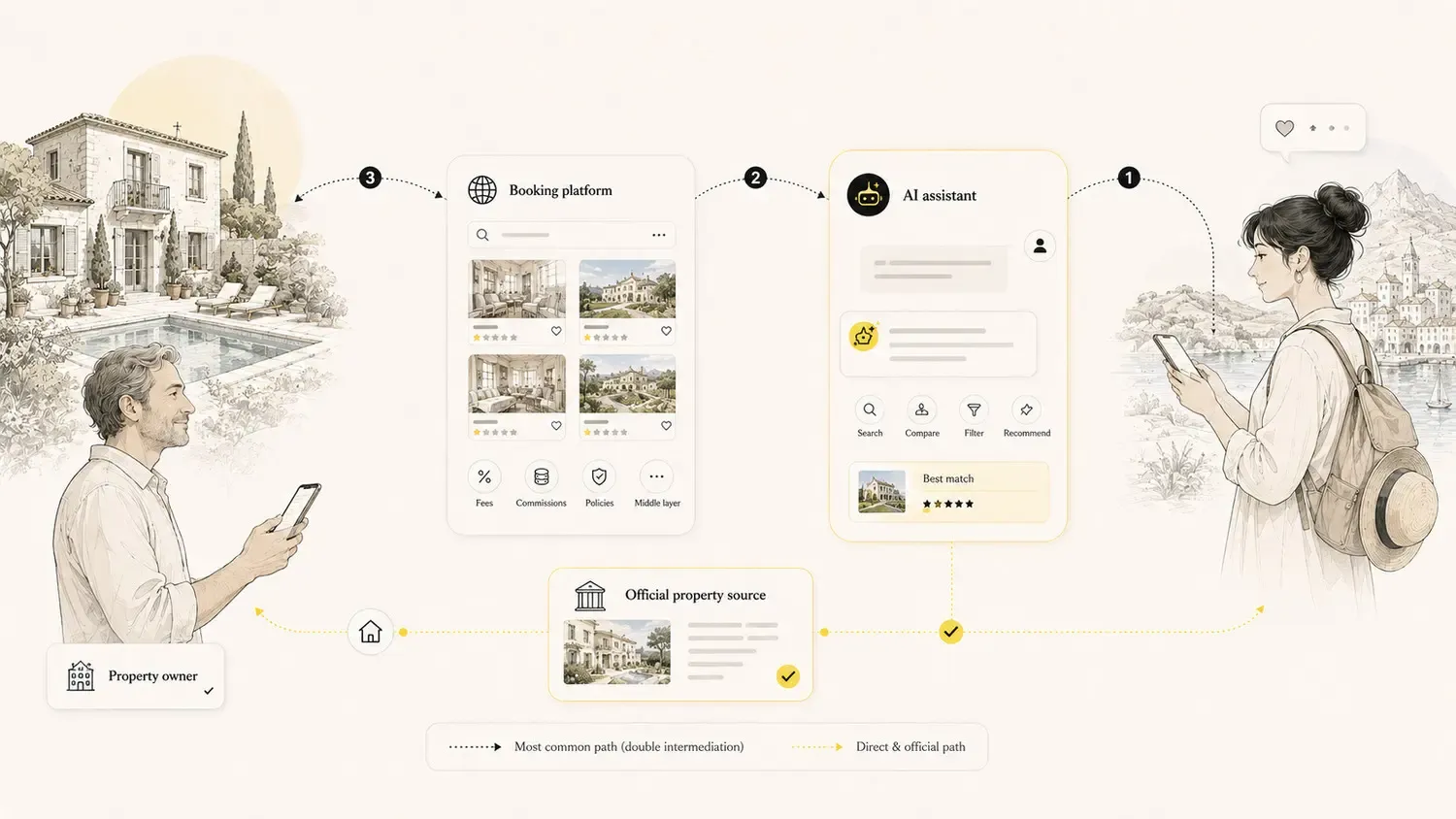
A new layer between host and traveler
Booking.com already lets travelers search for accommodation from ChatGPT. Airbnb is testing more conversational search along with a Q&A system about the property and its surroundings. The more structured information platforms have, the more they can feed into the answer given to the traveler.
You don't have to leave the platforms. But you shouldn't have to depend on them to describe your property.
02 · The problem
The details that determine whether a property gets chosen are spread across the website, listings, the welcome book, documents, messages, and the host's memory. An AI can't answer correctly with information it can't find, or that's contradictory or outdated.
Information is spread across
03 · The Weftd source
Weftd gathers the information from your website, listings, documents, and messages into a Space. You review and validate it. It can then feed a page, a conversation, or a compatible agent, in several languages.
Weftd doesn't replace your website, your listings, or your booking engine. It complements them with a shared, structured, up-to-date source.
Weftd isn't a chatbot. A chatbot is a point of contact; Weftd builds the source that powers it.
Website, listings, welcome book, manuals, house rules, messages, photos, and recommendations.
Organize information by property, amenity, rule, service, surroundings, and language.
Link content together, suggest translations, and flag what's missing.
You stay in control: nothing becomes official without your validation.
Reuse the source on a page, in a conversation, with a compatible agent, or in your own content.
04 · Use cases
For travelers, it lets assistants answer with more precision. For hosts, it removes the need to look up and rewrite the same information for every use.
Traveler assistants
Give reliable answers before, during, and after the stay.
Host and team
Prepare answers and content faster from a single up-to-date source.
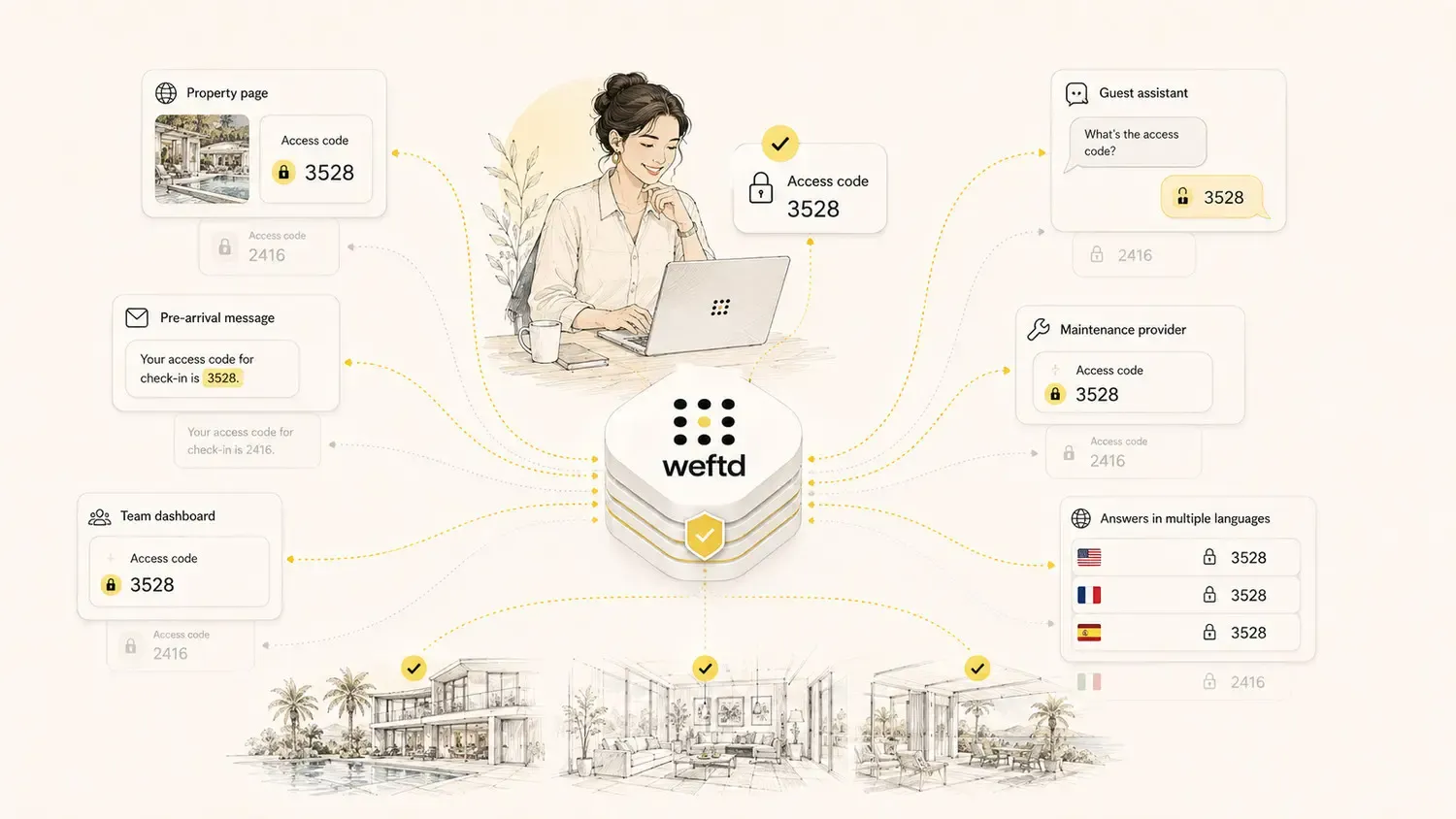
The host validates the information once. The team's tools and traveler-facing assistants can then rely on the same source.
05 · Concrete example
Pick a type of stay to see the information behind the answer.
A sample scenario: no AI is connected to this demonstration.Traveler's question
“Is the house suitable for two young children?”
Facts drawn on
Travel crib available
High chair available
Pool with a lockable gate
Traveler's question
“Can two people work comfortably here, and can we bring a dog?”
Facts drawn on
Fiber advertised at 300 Mb/s
Two work spaces
Pets accepted on request
Enclosed garden
Pet policy up to date
Traveler's question
“What can a family do near the house during two rainy days?”
Facts drawn on
Museum 12 minutes away
Covered market on Saturdays
Cinema 18 minutes away
Board games in the house
Recommendations verified in July 2026
06 · What this changes
Stay in control of official information
Surface the details that set each property apart
Answer traveler questions faster
Reduce scattered information and the risk of contradictions or outdated content
Reuse the same base for guest relations, support, and communication
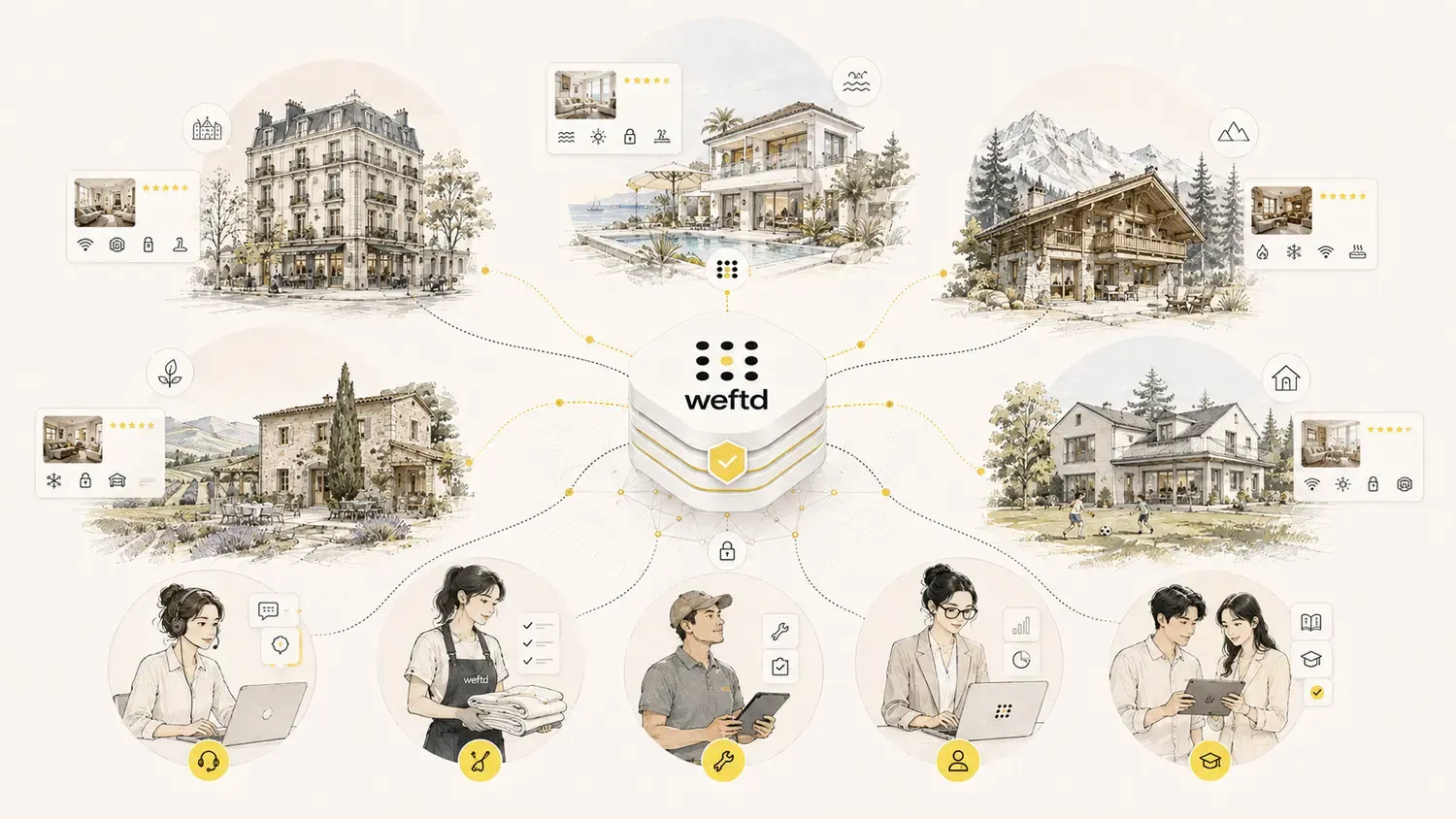
Roll out a shared structure across several properties
Weftd improves access to accurate, verifiable information. It doesn't guarantee that an assistant will discover or recommend a property.
Property management companies and portfolios
Each property keeps its particularities, but its information follows a shared structure. A property manager can update an amenity, a rule, or a service at the right level: for one property, a group of properties, or the whole portfolio.
 Weftd · 2026
Whitepaper · September 2026
In 26 pages, discover how travelers already use AI, why platforms are taking a growing role in the answers travelers get, and how to structure your rental's information.
Frequently asked questions
No. Your website, listings, and tools stay in place. Weftd gathers the information they contain into a Space you can validate, update, and reuse.
No. A chatbot is a conversational interface. Weftd first organizes the knowledge that can feed a page, a conversation, or a compatible agent.
Not to get started. Weftd starts from what you already have: your website, listings, documents, messages, and welcome book. Further connections depend on your tools and the plan you choose.
You do. Weftd can import, extract, link, and enrich your content, but nothing becomes official without human validation.
Yes. You choose what's public, restricted to your team, or shared for a specific use, depending on the plan you choose.
Yes. Weftd is also built for property management companies and portfolios. The number of Spaces and how it's deployed depend on the plan you choose.
Compatible assistants can consult a structured page, query a conversational experience, or connect to the source via MCP. Weftd makes reliable information easier to access; it doesn't guarantee that a property will be discovered or recommended.
Yes. That's actually the most common starting point. Weftd first gathers what already exists, then helps you spot what's missing or contradictory.
Tomorrow's Web will need a source.
Get the whitepaper or talk to us about creating your first Space.