A search, then several pages to check
The resident found the town's website, opened several sections, and pieced the answer together themselves.
"town hall opening hours"

Weftd for local governments
Your information already exists, but it's scattered across the town's website, documents, directories, and staff knowledge. Weftd gathers it into a space your teams can verify, date, and keep up to date.


Your town
AI Presence
I'm moving in September with a child: what steps do I need to take?
Mairie de Verlon
Local government · Auvergne-Rhône-Alpes
Public service · Updated Sept. 2026
View services & hoursThe shift
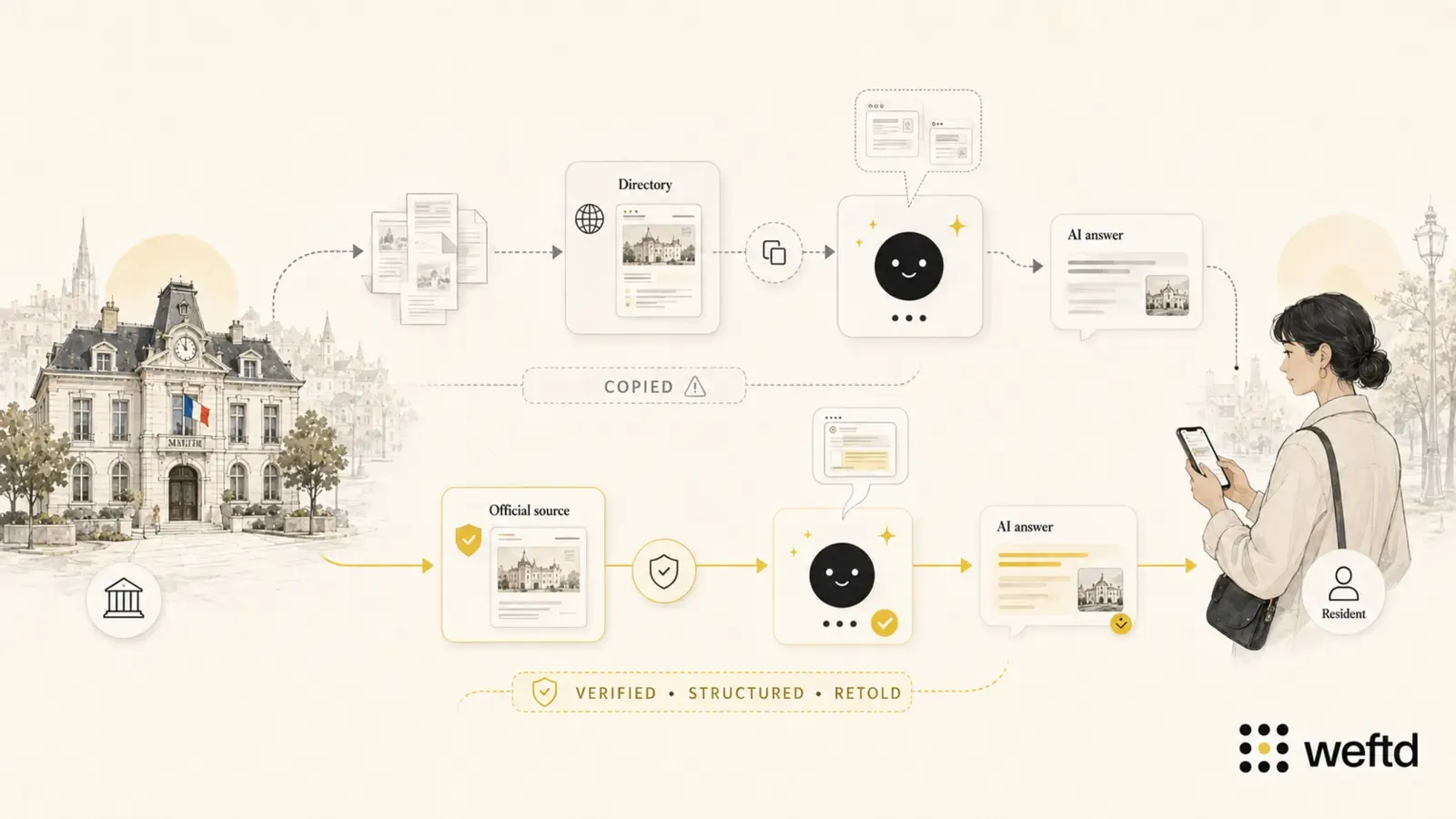
A resident no longer just searches "town hall + city name." They describe their situation and expect a directly usable answer, forming an idea of the process before ever opening the town's website.
The resident found the town's website, opened several sections, and pieced the answer together themselves.
"town hall opening hours"
The assistant interprets the request, consults the sources it has access to, and composes an answer. It only points the resident to the town's own channels in certain cases.
"I'm moving in September with a child: what steps do I need to take?"
Being found is no longer enough. The town also needs to be identifiable as the official source of the answer.
The operational risk
A summer schedule, a deadline, or a local exception can be up to date on the town's website and outdated everywhere else. The assistant doesn't always flag these gaps.
The resident acts on incomplete or outdated information.
The expected time savings turns into time spent verifying and explaining.
To the resident, the answer is the town hall's, even when it came from a third-party assistant.
Three audiences
Residents, visitors, and partners don't ask the same questions. All of them need information that's understandable, up to date, and validated by the town.
01
Opening hours, required documents, fees, conditions, deadlines, and the right department to contact: the knowledge base answers recurring questions and points to the portal as soon as an action is needed.
02
Places to visit, opening periods, parking, transport, and events: the information can be used directly, including in another language.
03
The intermunicipal body, tourism office, associations, schools, and local businesses can rely on dated information instead of copying divergent versions.
The Weftd method
Weftd gathers the town's information into a knowledge space called a "Space." Your teams can structure it, verify it, and keep it up to date before it's used across different touchpoints.
Web pages, documents, bulletins, event calendars, directories, open data, and information entered by departments.
Hours, conditions, deadlines, contacts, application periods, sources, and the links between pieces of information.
The relevant teams correct, date, and publish the information. Nothing becomes official without their approval.
The information can feed a conversational page, a module built into the website, an API, or compatible assistants.
The questions being asked reveal missing answers and content that still needs to be completed.
For every piece of information, the town keeps four reference points
What Weftd doesn't replace
Weftd replaces neither the town's website, nor its e-government portal, nor its business software. It complements these tools and points to the right one whenever an action or human verification is needed.
What the source changes
Every piece of information used in an answer can be linked to a source, a date, and a validation.
Answers to frequent questions are prepared in advance, without removing the option to reach a staff member.
The work done for residents can also serve phone reception, staff, and partners.
Concrete example
A sample town, shown to demonstrate the approach. No AI assistant is connected to this page.
User's question
“Is parking paid in the town center in August?”
Information used
Example answer
Parking is free from August 1 to 31 on streets in the town center. It remains paid in the station car park. The answer cites the order published by the town and states its update date.
User's question
“When should we submit our file for a wedding planned in July?”
Information used
Example answer
The answer isn't based on a generic deadline. It uses the deadline validated by the civil status office, the official list of documents, and the contact details to use if the couple's situation needs review.
User's question
“What can we visit on Sunday without a car, with two kids?”
Information used
Example answer
The answer cross-references places that are actually open, walking or transit times, and the family's constraints. It can suggest a route and point back to the official source for hours that may change.
Where to start
The front desk is often the best first scope. Staff already know these questions, their number is limited, and results can be observed quickly. The knowledge space can then expand, department by department.
List the recurring questions and the answers actually given.
Gather the pages, documents, rules, and local exceptions needed to answer them.
Have each piece of information validated and dated by the relevant department, then identify who is responsible for keeping it up to date.
Deploy a first touchpoint, spot unanswered questions, then fill in the information.
Three possible indicators to track this first scope
Share of frequent questions with a validated answer
Average time to update a piece of information
Number of unanswered questions detected on the tested touchpoint
The whitepaper
The whitepaper explains how search habits are changing, what that means for local public service, and how to build a controlled presence in the answers produced by assistants.
Frequently asked questions
No. Weftd starts by organizing the town's official information. A conversational interface can then use it, but it's only one touchpoint among others.
No. The website remains the official channel for publishing information, presenting procedures, and letting residents complete them. Weftd structures the information and points back to the town's tools whenever an action is needed.
No. No one controls a third-party assistant's final answer. Weftd makes official information accessible to compatible assistants; whether they use it then depends on the protocols, integrations, and permissions available.
Yes, by starting with a limited number of frequent questions. Pooling resources with the intermunicipal body, a syndicate, or a public digital operator can also be considered.
The town's teams verify, date, and publish the information. The answer points to a staff member whenever a situation requires a decision, a case review, or a conversation.
The forms collect your business contact details and any information you choose to add, in order to process your request. Weftd's privacy policy specifies the purposes, retention periods, recipients, and how to exercise your rights. The specific terms for a town's data must be reviewed and contracted for each deployment.
The recurring questions received at the front desk are often the best starting point. They're known to staff, limited in number, and let you quickly spot missing information.
Build the first scope
Let's talk about the questions your staff receive most often, the information already available, and the first touchpoint to equip. The goal isn't to launch a large IT project, but to define a useful, realistic scope.
Administrative procedures top the list of areas where French people expect help from an AI assistant: 34% (Ifop study for Converteo, March 2026).